
Start with the agenda. Under each item, write down what the group decided, who agreed to do the work and when it’s due. Before everyone leaves, read the tasks back. A quick “Priya, when can you have that ready?” is easier to answer on the call than in a chain of follow-up emails.
Download the free Word template or see the filled-in example.
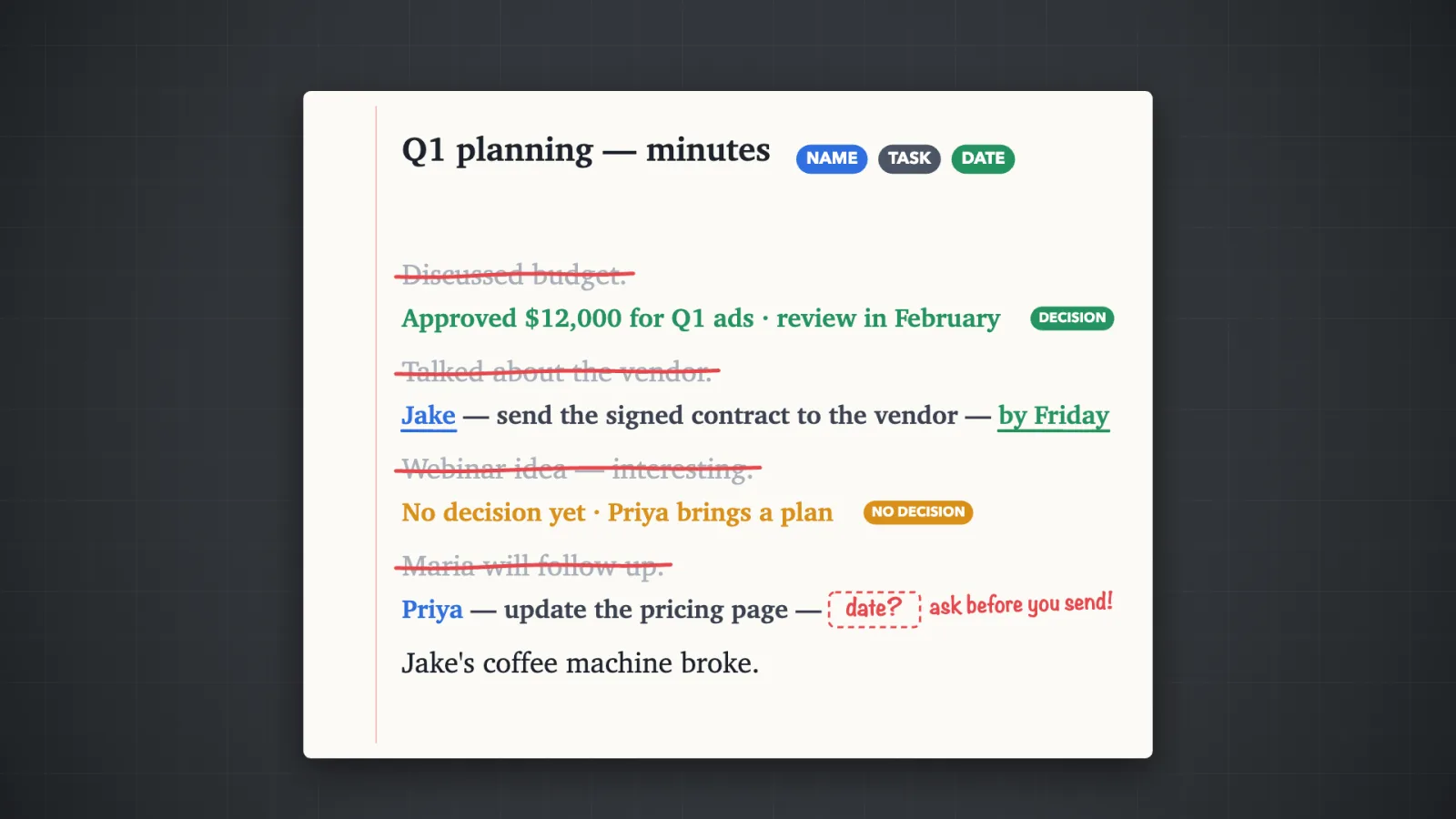
In our analysis of AI-drafted minutes, 64% of action items had no deadline in the draft. The example below shows what to write when someone takes a task but leaves the date open.
Prefer to watch? See how to turn rough notes from a short planning meeting into finished minutes in under three minutes.
Meeting minutes example: the same meeting, before and after
This scripted example follows a Q1 marketing meeting on 18 November 2026. Maria chairs the meeting and Priya takes the minutes.
Jake asks for $15,000 for ads. Engineering needs money for analytics too, so Maria suggests $12,000 with a review in February. Everyone agrees. Jake agrees to send the signed contract to the vendor by Friday. Priya offers to update the pricing page, which still lists last year’s plans. She doesn’t give a date.
Priya also suggests a February webinar for the new templates. Maria wants to wait. “I’ll bring a short plan on Tuesday so we can decide then,” Priya says. Maria confirms the spring campaign will launch on 3 March and sets the next meeting for Tuesday at 14:05. Jake mentions that his coffee machine broke.
Rough notes from the meeting
Q1 planning — minutes
Discussed budget.
Talked about the vendor.
Webinar idea — interesting.
Maria will follow up.
Jake’s coffee machine broke.
What to keep when you write them up
| Before | After | Why |
|---|---|---|
| Discussed budget. | Approved $12,000 for Q1 ads; review in February. | A decision, not a topic |
| Webinar idea — interesting. | Webinar decision deferred. Priya will bring a plan on Tuesday. | A non-decision, recorded as one |
| Talked about the vendor. | Jake — send the signed contract to the vendor — Friday. | Owner, task and date |
| Maria will follow up. | Priya — update the pricing page — date: ask Priya. | The right owner; the missing date is flagged, not guessed |
| Jake’s coffee machine broke. | (cut) | Not part of the record |
The finished minutes
Q1 Marketing Planning — Minutes
18 November 2026, 14:05 · Attendees: Maria (chair), Jake, Priya · Minutes: Priya
Summary. The team approved the Q1 ads budget and confirmed the spring launch date. The webinar decision is open.
Key points.
- The ads request was $15,000; engineering also needs budget for the analytics setup.
- The pricing page still shows last year’s plans.
- A webinar in February was proposed to launch the new templates.
Decisions.
- Approved $12,000 for Q1 ads; review the numbers in February.
- The spring campaign launches on 3 March.
- Webinar: no decision yet.
Action items.
- Jake — send the signed contract to the vendor — Friday, 20 November.
- Priya — update the pricing page — due date to confirm with Priya.
- Priya — bring a short webinar plan — Tuesday, 24 November.
Next steps. Next meeting: Tuesday, 24 November at 14:05.
Jake can see exactly what he promised. Priya has one date to confirm before she circulates the minutes.
Free meeting minutes template
Download the meeting minutes template (Word, .docx) — no sign-up. It has the six parts, an action-item table with owner, task and due-date columns, and an extra table for board and committee motions. It opens in Word or Google Docs.
To start in a shared document, copy these six headings:
[Meeting name] — Minutes
Date and time:
Attendees:
Absent:
Minutes taken by:
Summary (1–2 sentences):
Key points
-
-
Decisions (or “No decision” + who brings what next time)
-
-
Action items (owner — task — due date)
-
-
Next steps
Next meeting:
Open questions:
The 6 parts of meeting minutes at a glance
| Part | What to write | Example | Common mistake |
|---|---|---|---|
| 1. The basics | Meeting name, date, time, attendees, absentees, who took the minutes | Q1 Marketing Planning · 18 Nov 2026 · Maria, Jake, Priya | Leaving out who was absent |
| 2. Summary | One or two sentences: why you met and what came out of it | Agreed the ads budget, the contract handoff and the launch date | A paragraph that retells the meeting |
| 3. Key points | Short, neutral facts that explain the decisions | The ads request was $15,000; engineering also needs budget | Who said what, word for word |
| 4. Decisions | What was agreed — or that nothing was | Approved $12,000 for Q1 ads, review in February | “Discussed the budget” |
| 5. Action items | Owner — task — due date, one line each | Jake — send the signed contract to the vendor — Friday | “Maria will follow up” |
| 6. Next steps | Next meeting, open questions, what is parked | Next meeting: Tuesday, 24 November at 14:05 | Ending without a next date |
How to write meeting minutes in 6 steps
1. Turn the agenda into a template before the meeting
Copy the six parts above into a document and fill in what you already know: the meeting name, the date, the invited attendees and one heading per agenda item under key points. You will spend the meeting filling gaps instead of building structure. If there is no agenda, ask the organiser for the goal in one sentence — "Decide the Q1 ads budget" — and use that as your summary placeholder.
2. Record who is there
Tick off attendees as they join and note anyone who was invited but absent. For a board or committee, also note whether there is a quorum and the time the meeting was called to order. On a video call, the participant list does this for you; take a screenshot.
3. Write decisions, not discussions
This is the rule that separates minutes from notes. When the group reaches an outcome, write the outcome, not the conversation that led to it:
4. Give every action item a name, a task and a date
Give each task a line of its own so the person doing the work can find it again. Use owner — task — due date.
If a date is missing, ask while the owner is still there. Try “Priya, could you have the pricing page ready by Friday?” If she needs to check first, write “Due date to confirm with Priya” and follow up when you send the draft.
5. Write them up within 24 hours, on one page
Turn your notes into the final format while the meeting is fresh. Use the past tense and a neutral voice ("The team approved…"), cut side conversations, jokes and repeated points, and keep it to one page for a normal team meeting. If you recorded the meeting, check numbers, names and dates against the recording rather than your memory.
6. Send them, ask for corrections, then store them
Send the minutes to every attendee and to anyone who owns an action item but was absent. End the message with a deadline for corrections: "Anything wrong or missing? Reply by Thursday." For formal bodies, the minutes are approved at the next meeting, "as presented" or "as corrected." Then file them where people can find them — the same folder or tool every time, named consistently, such as 2026-11-18 Q1 Marketing Planning — Minutes.
How often did the draft include a deadline?
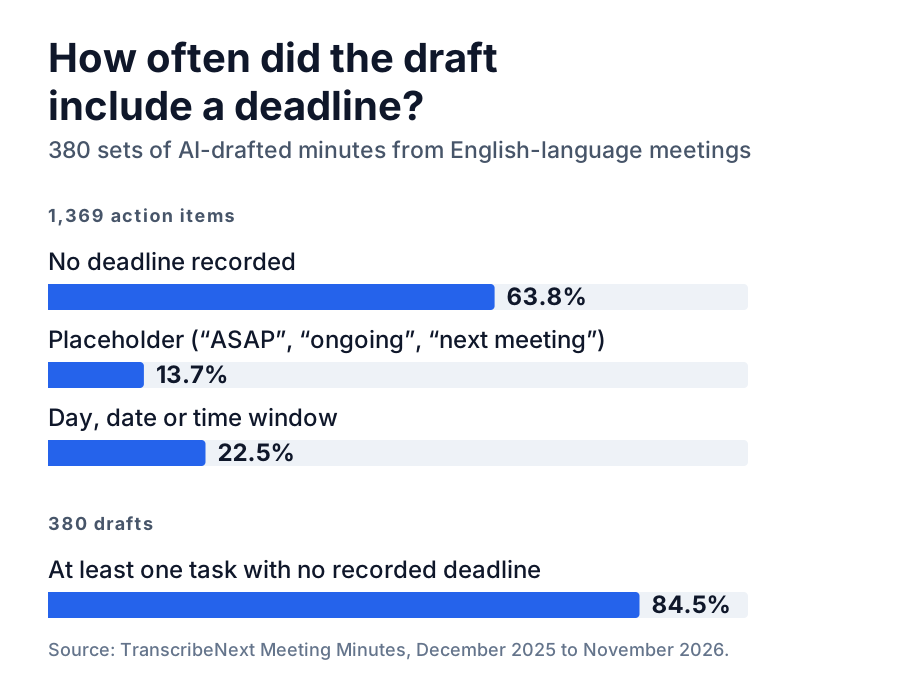
We counted 1,369 action items in 380 sets of AI-drafted meeting minutes. For each item we looked at what a reader could learn from the due-date field. The draft alone can’t tell us whether someone on the call gave a date that the software missed.
| Due-date field | Example | Share of action items |
|---|---|---|
| No deadline recorded | Blank, “not stated” or “TBD” | 63.8% |
| Placeholder | “ASAP”, “ongoing” or “next meeting” | 13.7% |
| Day, date or time window | “Friday”, “25 November” or “next week” | 22.5% |
In 84.5% of the 380 drafts, at least one task had no deadline recorded. When you review your own draft, start with those blanks. Then check any relative dates. If “next meeting” means Tuesday and the invitation is already in the calendar, write down Tuesday’s date.
How to write board meeting minutes
Board, committee and association minutes follow the same rules with more formality, because they can be read later by auditors, regulators or a court. Add these to the template:
What to leave out is the same as for any minutes. As Robert’s Rules of Order puts it, minutes are "a record of what was done at a meeting, not a record of what was said"; summarising the debate is not only unnecessary but, in its words, improper. Corrections made before approval go into the text being approved; corrections after approval need a formal motion, and the original minutes are not rewritten.
For US nonprofits filing Form 990, the IRS asks about meetings and written actions of the governing body and committees authorised to act on its behalf. It treats documentation as timely if it is completed within 60 days of the meeting or action, or by the next meeting if that comes later. Check your bylaws and local law for the rules that apply to your board.
Phrases that make minutes clear
| Instead of | Write |
|---|---|
| We talked about pricing. | The team agreed to keep current prices until March. |
| Lots of discussion about the launch. | The launch moved from 1 to 15 March. |
| Someone will look into it. | Priya — compare three vendors — 25 November. |
| ASAP | By Friday, 20 November |
| Tom was against the idea. | Concerns about cost were raised; decision deferred to the next meeting. |
| The board voted on the budget. | Lee moved to approve the 2027 budget. The motion passed with five votes in favour and none against. |
Meeting minutes vs meeting notes vs a transcript
| Minutes | Notes | Transcript | |
|---|---|---|---|
| Purpose | The official, agreed record | Help one person remember | Every word, for reference |
| Contents | Attendees, decisions, action items | Whatever the writer wants | Everything said, with speakers |
| Length for a 36-minute meeting | About one page | Varies | About 5,000 words |
| Who reads it | Everyone, including absentees | The writer | Whoever needs to check a detail |
| Approved? | Yes, for formal bodies | No | No |
The transcript is the best raw material for minutes: you can check every number and name in it. It is not a substitute for them — nobody acts on 5,000 words.
How to take minutes when you are also in the meeting
Taking good minutes while also contributing is hard, and meetings take up a lot of the week — nearly 23 hours for the average executive, according to Harvard Business Review. Nobody can write all of that up by hand. Three ways to make it easier:
Good minutes start with a good meeting. If yours keep ending without decisions, our virtual meeting etiquette guide has the rules for agendas and endings, backed by 766 real calls.
Common meeting minutes mistakes
How we got these numbers
We analysed 380 sets of minutes drafted by TranscribeNext from English-language meeting recordings between 19 December 2025 and 19 November 2026. We counted the 1,369 entries under “Action Items” and classified the text in each due-date field.
A blank field, “not specified”, “not stated” or “TBD” counted as missing. Placeholders included “ASAP”, “immediately”, “ongoing” and references to the next meeting or session. The remaining entries gave a day, date or time window, including “tomorrow”, “next week” and “the end of the week”. A time window can still leave the exact day open.
Across the three versions of the minutes format used during this period, the share of action items with no recorded deadline was 66%, 60% and 63%, respectively. Counting was automated. Only aggregate results left the database.
The sample covers people who recorded a meeting and requested minutes. We did not compare the drafts with the audio or with the versions people eventually circulated.
The short version
Before you send the minutes, ask whether a colleague who missed the meeting could act on each entry. If Jake can find the contract, the recipient and the deadline in one line, that entry is ready. If Priya’s date is still open, flag it and ask her to confirm.
Download the free template, or let TranscribeNext draft the minutes from your next recording.
Sources
Frequently asked questions
What are meeting minutes?
Meeting minutes are the official written record of a meeting: who attended, what was decided, and who will do what by when. They are not a transcript and not anyone’s personal notes. Robert’s Rules of Order puts it in one line: minutes are a record of what was done at a meeting, not a record of what was said.
What should be included in meeting minutes?
Six parts: the basics (meeting name, date, time, attendees and absentees), a one- or two-sentence summary, key points, decisions, action items with an owner, a task and a due date, and next steps such as the date of the next meeting. For a board meeting, also record whether there was a quorum and whether the previous minutes were approved. For each main motion, give the wording, the mover and the outcome. Include the seconder’s name only if your rules or the assembly require it.
How long should meeting minutes be?
One page for most team meetings. In the 380 sets of minutes we analysed, from meetings with a median length of 36 minutes, the typical document was about 280 words, and about 490 in the fuller format we use today. Board minutes run longer because motions and votes have to be recorded exactly, but they still should not summarise the debate.
What is the difference between meeting minutes and meeting notes?
Meeting notes are informal and personal: whatever helps you remember. Meeting minutes are the shared, official record that the group agrees is correct, so they stick to decisions, action items and outcomes, use a consistent format, and are sent to everyone and stored. A transcript is a third thing: every word, useful as the source for minutes but too long to act on.
How soon should meeting minutes be sent out?
Within 24 hours, while people still remember the meeting and can correct mistakes. Formal bodies often approve minutes at the next meeting. For US nonprofits that file Form 990, the IRS treats documentation as contemporaneous if it is done by the later of two dates: the next meeting or 60 days after the meeting being documented.
Should meeting minutes say who said what?
Usually not. Record outcomes, not the debate. Name people where it matters: attendees, the owner of each action item, and, in formal minutes, who moved each main motion. Follow your board’s rules on recording other names. Attributing opinions to individuals makes minutes longer, more sensitive and harder to agree on.
Who should take the minutes?
Someone who is not running the meeting. The chair has to steer the discussion; the minute-taker has to listen for decisions and ask ‘who owns that, and by when?’. Many teams rotate the role. If you have to do both, ask everyone if you can record the meeting and check your notes afterwards.
Are meeting minutes legally required?
For many formal bodies, yes or effectively yes: corporate boards, nonprofit boards, public bodies under open-meeting laws and many associations are required by law or their own bylaws to keep minutes. Ordinary team meetings have no such requirement. Rules differ by country, state and organisation type, so check your bylaws or ask a lawyer; this is not legal advice.
Can AI write meeting minutes?
AI can write a good first draft from a recording: attendees, decisions, action items and next steps in a standard format. Treat it as a draft. Check every decision and every action item against what was actually agreed, fill in missing owners and dates, and make sure everyone knew the meeting was being recorded. A good AI draft marks a missing deadline as ‘not stated’ instead of inventing one.
What tense should meeting minutes be written in?
Past tense, third person, neutral tone: ‘The team approved a $12,000 budget for Q1 ads.’ Action items are the exception — they describe future work, so write them as tasks: ‘Jake — send the signed contract to the vendor — Friday.’